Why more and more businesses, large and small, are investing in solar: benefits, costs and incentives.
Solar is now one of the most concrete ways for Italian businesses to become more competitive. Rising energy costs and growing attention to sustainability are pushing more and more companies – small, medium and large – to invest in solar.
In this article you’ll find out why it pays, how it works, what it costs, how long it takes to pay back, which incentives are available and how to choose the right partner for an investment that really delivers, and lasts.
Installing solar isn’t just an environmental choice – above all, it’s a long-term financial strategy. Companies investing in renewables today can cut their energy spending significantly and improve their environmental reputation.
When electricity is one of your biggest costs, producing part of what you need in-house protects your operating margins and makes the company more financially stable.
On top of that, sustainability matters more and more in supply chains: many customers choose suppliers with environmental certifications or active ESG plans, which makes solar a genuine competitive advantage.
A solar system can cut your electricity bill by up to 100%, depending on how much of the energy you use yourself.
For a company with high energy demand – in manufacturing or logistics, for example – that can mean savings of tens of thousands of euros a year.
Solar also stabilises energy costs: the company is no longer at the mercy of the electricity market, because it has its own source of supply.
Over time the investment turns into a steady positive cash flow, with a predictable, measurable return.
Sustainability is no longer optional: the market and consumers value it.
Companies that choose solar show their commitment to the energy transition in practice, and can highlight it in sustainability reports, ESG reports and marketing campaigns.
Being “green” builds trust, strengthens your reputation and helps relationships with customers, investors and institutions.
A business solar system can also become part of a sustainable brand strategy, strengthening the company’s positioning and making it more attractive in the market.
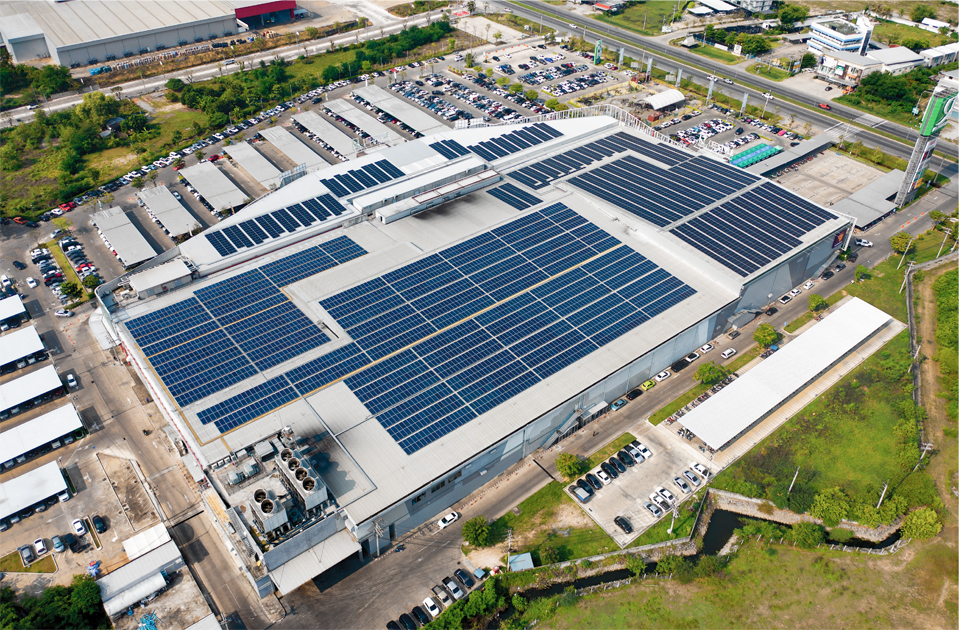
A solar system converts sunlight into electricity that can power machinery, offices and company buildings.
For a business, sizing is more complex than for a home, because the system has to match the specific consumption of the operation.
Every project starts with an analysis of consumption data and an assessment of the available surfaces (roofs, ground or canopies).
The aim is to maximise self-consumption – using the energy produced directly to buy less from the grid – and only then to feed any surplus into the grid.
A business solar system consists of:
The principle is simple but powerful: the more energy you use directly, the more you save and the faster the investment pays back.
The upfront investment depends on the size and type of system.
The average cost is between €1,000 and €1,300 per kW installed, depending on the complexity of the project, the type of structure and whether or not storage batteries are included.
A 100 kWp system, for example, can cost between €100,000 and €130,000, but delivers annual savings and income of up to €25,000–30,000, with a payback period of between 3 and 5 years.
Adding storage increases the investment, but gives you more autonomy and steadier savings over time.
Beyond the direct financial return, there’s the strategic value: less energy dependence, higher property value and a better ESG rating.
Companies can choose between two main models:
Self-consumption usually pays more for businesses with high daytime consumption, while selling makes sense for large systems or where there’s a constant surplus.
The best solution is often a mix: maximise self-consumption and sell only the surplus, to get the most out of the system overall.
Companies investing in solar in Italy can draw on several schemes, which can often be combined. The main ones today are:
Requirements, percentages and deadlines change often: before planning the investment, check which schemes are open and whether they can be combined in your case.
Using these schemes can drastically reduce the upfront investment and improve the overall return on the project.
Green Terrae also handles the red tape and incentive applications for you, quickly and transparently.